Connectivity |
Remark. A walk may repeat a vertex and an edge. A path of length \(n\) between vertices \(v_0\) to \(v_n\) is a walk of length \(n\) from \(v_0\) to \(v_n\) that has no repeated vertices and edges which can be simply written in the form \(v_0v_1v_2\cdots v_n\) in a simple graph.
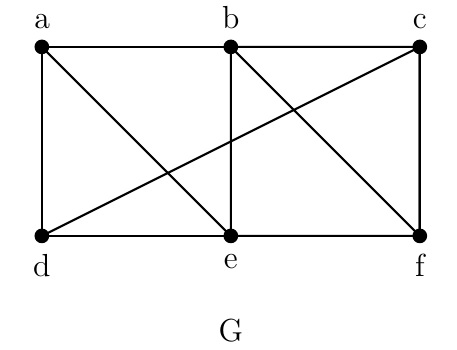
Example. In the above graph \(G\), \(abcf\) is a walk and also a path of length \(3\). \(abcfb\) is a simple walk of length 4, but not a path because of the repeated vertex \(b\). The walk \(abcfba\) is a circuit of length 6.
Example.
In the above graph \(G\), \(\operatorname{d}(a,a)=0\), \(\operatorname{d}(a,e)=1\), and \(\operatorname{d}(a,f)=2\).
Remark. The concept of distance is used to define Erdös number (the collaboration distance from Paul Erdös), Bacon number etc.
In 2016, the average distance in the Facebook friend graph was \(4.57\), i.e., \(3.57\) intermediaries or "degrees of separation."
It is said that everyone on the planet is connected to everyone else by six other people ("six degrees of separation").
Example.
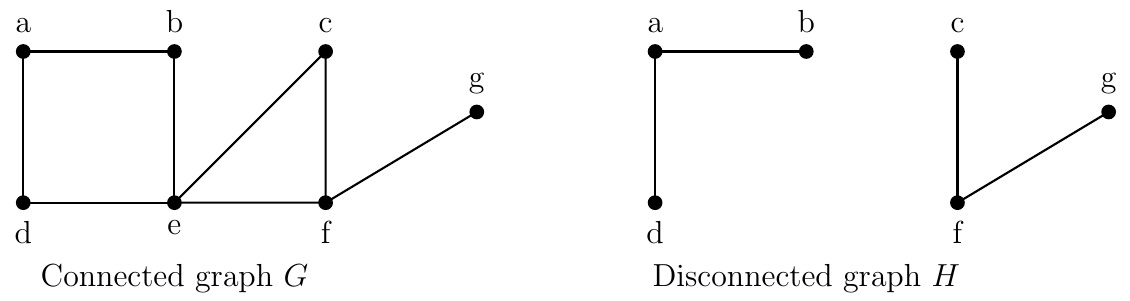
The above graph \(G\) is connected, i.e., it has one connected component. But the above disconnected graph \(H\) has two connected components.
Example.
\(99.91\%\) of Facebook users belong to a single large connected component in the Facebook friend graph.
How do we measure the well-connectedness of a graph? One idea is to count the minimum number of vertices or edges whose deletion makes the graph disconnected.
Example. The vertex \(e\) is a cut vertex of the above graph \(G\). Note that if \(v\) is a cut vertex of a connected graph \(G\), then \(G-v\) is disconnected. The edge \(\{f,g\}\) is a bridge of both \(G\) and \(H\). Note that \(K_n,\;n\geq 3\) has no cut vertices and bridges.
Remark.
Note that \(\lambda(G)=n-1\) if and only if \(G=K_n\). So \(0\leq \lambda(G)\leq n-1\) for any graph \(G\) on \(n\) vertices.
Example.
\(\lambda(P_n)=1\) for \(n\geq 2\) and \(\lambda(C_n)=2\).
Remark.
\(0\leq \kappa(G)\leq n-1\) for any graph \(G\) on \(n\) vertices. Note that if \(G\) is \(k\)-connected, then \(G\) is \(j\)-connected for
all \(j=0,1,\ldots,k\). Also \(\kappa(G)\) is the greatest integer \(k\) for which \(G\) is \(k\)-connected.
Example.
The minimum degree of a vertex in a graph \(G\) is denoted by \(\delta(G)\).
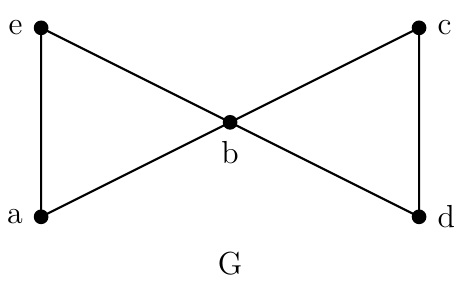
Example. Consider the above graph \(G\).
Solution. (a) The vertex cuts of \(G\) of size at most \(2\) are \(\{b\},\{b,a\},\{b,c\},\{b,d\},\{b,e\}\).
The edge cuts of \(G\) of size at most \(2\) are \(\{\{b,c\},\{b,d\}\}, \{\{b,a\},\{b,e\}\}\), and the sets of two edges incident with
\(a,e,c,d\).
(b) \(\kappa(G)=1\), \(\lambda(G)=2\), \(\delta(G)=2\), and we have
\[\kappa(G)=1 < 2=\lambda(G)=\delta(G).\]
Connectivity of digraphs
Remark. A walk may repeat a vertex and an arc. A directed path of length \(n\) from \(v_0\) to \(v_n\) is a walk of length \(n\) from \(v_0\) to \(v_n\) that has no repeated vertices and arcs which can be simply written in the form \(v_0v_1v_2\cdots v_n\) in a simple digraph.
Remark. If a digraph \(G\) is strongly connected, then it is weakly connected. The converse is not true in general.
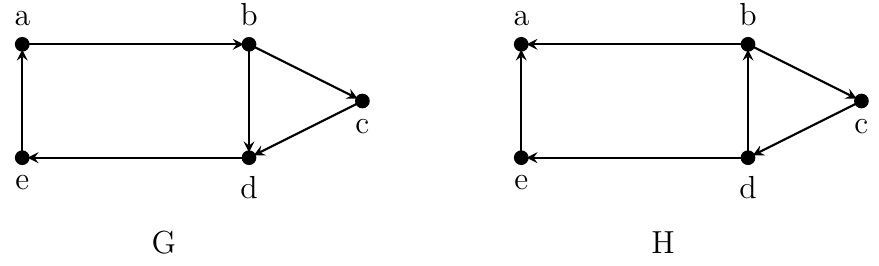
Example. Above digraph \(G\) is strongly connected and weakly connected. Above digraph \(H\) is not strongly connected (since there is no walk from \(a\) to \(b\)) but \(H\) is weakly connected.
Example.
The above digraph \(H\) has 3 strongly connected components: \(a;e\); and the subdigraph on vertices \(b,c,d\) with arcs \((b,c),(c,d),(d,b)\).
Example.
A webgraph in 1999 with 200 millions vertices and 1.5 billion arcs was studied. It was not strongly connected but it had lots of
strongly connected components covering \(90\%\) of the vertices of the webgraph.
Last edited